
 M.AI
M.AIRecipes, etchants, and defect diagnosis from inside every sample.
Mai is an AI prep assistant for metallography labs. It draws on the PACE Metallographic Handbook, your lab's own recipe book, and a 2,700-entry etchant catalog to answer the questions a metallographer would otherwise ask a senior colleague.
- $49/month per organization
- Available on every plan, including Free
- Cancel from the customer portal anytime
The questions a metallographer asks every day.
Recipe recommendations
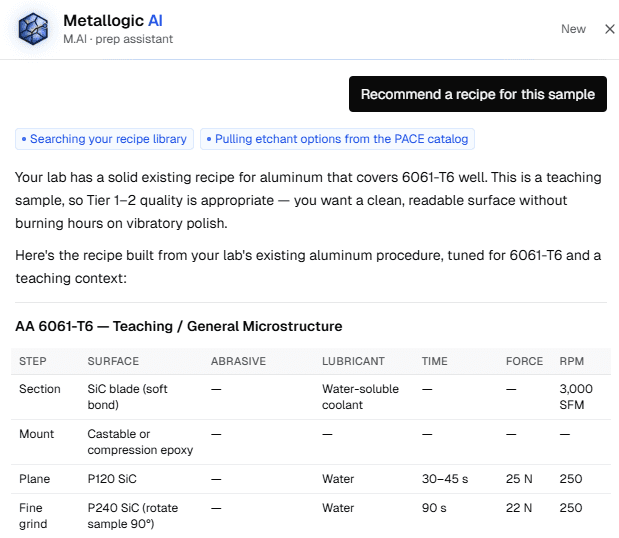
Mai drafts a complete ladder (section, mount, grind, polish, etch) sized to the sample, the analysis goal, and what your lab already stocks. Saves to your recipe book and links to the active sample in one click.
Etchant lookups
Mai searches the PACE catalog of about 2,700 etchants by material, designation, scale, and method. Returns composition, procedure, and what each etch reveals.
Defect diagnosis
Attach a photo of edge rounding, comet tails, pull-out, or smearing. Mai identifies the failure mode and proposes a corrected ladder grounded in the handbook's defect catalog.
Twenty-five years of metallography knowledge, distilled.
Mai is built on the PACE Metallographic Handbook, written by Donald Zipperian, Ph.D., PACE's Chief Technical Officer. Plus standard metallography practice across material families from carbon steels to refractory metals to magnesium.
- Recommendations bias toward gentler, lower-damage prep, matching PACE's philosophy.
- Honest about uncertainty: hedges when answering outside the handbook's coverage rather than fabricating parameters.
- Vendor-neutral: recommends prep characteristics (pad class, abrasive size, force, time) so the recipe works with whatever consumables your lab stocks.
- Reads your sample, your inventory, and your recipe book on every conversation. Recommendations align to what your lab can actually run today.
- Etchants in the catalog
- ~2,700
- Material families covered
- 80+
- Years of PACE bench work
- 25+
- Defect modes catalogued
- 20+
Steels, cast irons, stainless, aluminum, copper alloys, titanium, magnesium, superalloys, refractory metals, coatings, weld zones, ceramics, composites, electronic materials, covered in detail with prep ladders and etchant matches.
Mai opens from the sample you're already on.
No separate app, no separate window. The drawer slides in over the sample you're looking at, with the sample's material, hardness, mount, and goal already loaded.
Pre-loaded with context
Your sample's material, designation, hardness, mount, and goal, plus your lab's owned consumables and existing recipes for similar materials. Mai never asks for what's already in the database.
Answers, not preambles
Direct, technical, on-brand. Specific parameter ranges (force, time, RPM, grit), not vague generalities. Tables for procedural data. Defect-watch callouts on every recipe.
Save and apply, in one click
When Mai drafts a recipe, save it straight to your recipe book, and optionally link it to the current sample so the next prep step pre-fills from the recipe ladder.
One price. Any plan.
Add M.AI to any Materials Prep plan, including Free. One flat rate per organization with a generous monthly conversation budget.
- Recipe recommendations on every sample
- PACE etchant catalog lookup
- Photo-based defect troubleshooting
- Save and apply recipes in one click
- Available on every plan including Free
How your data is handled
When you use Mai, the content of your messages, attached images, and your sample's metadata (material, hardness, mount, recipe history) are sent to Anthropic for processing and returned. We do not use your prompts to train models, and Anthropic's data processing terms apply to the request-response cycle. Mai's recommendations are advisory; validate any recipe before using it for QA-graded work.